
The Uganda Muslim Supreme Council (UMSC) has expressed readiness to work with government agencies and other stakeholders to strengthen Uganda’s halal industry and position the country to benefit from the growing global halal economy.
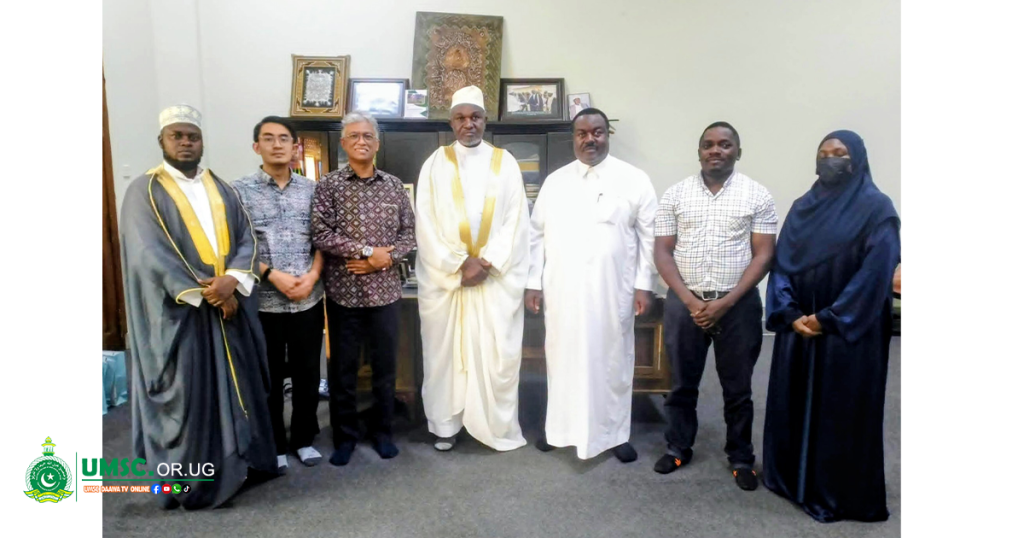
The Deputy Mufti, His Eminence Sheikh Muhammad Ali Waiswa, made the commitment on Friday, August 21, 2026, when he hosted a delegation from Malaysia’s Halal Development Corporation (HDC), an agency under the Malaysian Ministry of Investment, Trade and Industry.
The two-member delegation comprised Haj Mohd Zamulud Awang Kechik, Chief Commercial Officer, and Wan Ali Abbas Wan Mustafa Kamal, Adviser for Halal Consultancy and Advisory. They are in Uganda at the invitation of the Uganda National Bureau of Standards (UNBS).
The delegation was accompanied by UNBS officials, including Ms Mariam Nalwoga, Acting Manager of the Certification Department, and Mr Mbaziira Mahmodu, Head of Halal Certification.
Sheikh Waiswa received the delegation at the UMSC headquarters in Kampala in the presence of UMSC Secretary General Hon. Hadji Abbas Muluubya Ssekyanzi and the Director of the Halal Directorate, Sheikh Abdu-Karim Abdallah Katamba.
In his welcoming remarks, Sheikh Waiswa highlighted Uganda’s agricultural potential, including livestock and food production, as well as its expanding manufacturing and services sectors. “Therefore, a credible halal ecosystem can serve the Muslim community while at the same time creating opportunities for farmers, businesses, investors, exporters and the national economy,” Sheikh Waiswa said.
He said Uganda could draw lessons from Malaysia on how institutions and stakeholders can work together within an inclusive framework that respects Islamic principles while embracing science, standards and quality assurance.
He added that such a framework should be practical enough to cover the entire halal value chain, from grassroots producers and slaughter facilities to factories, supermarkets and export markets. Sheikh Waiswa pledged UMSC’s readiness to contribute to Uganda’s development of the halal industry while working closely with government authorities, agencies such as UNBS, the Muslim community and the private sector.
Earlier, Hadji Muluubya gave the delegation a brief background of the UMSC and reflected on the concept and practice of halal from traditional times to the modern era.
He said Uganda was interested in learning from Malaysia’s experience, particularly its institutional relationships, successes and lessons, so that relevant aspects could be adapted to Uganda’s legal, religious, economic and social circumstances.
Muluubya said UMSC wants to see a halal ecosystem that is Sharia-compliant, technically credible, legally sound and inclusive, while remaining practical for industry, accessible at the grassroots, trusted by consumers and capable of positioning Uganda within the global halal economy.
Haj Mohd Zamulud Awang Kechik thanked the UMSC for the warm reception and expressed the delegation’s willingness to engage further with the Council in the future.
Before departing, the Malaysian delegation attended Friday congregational prayers at the Uganda National Mosque, where Sheikh Juma Ali Shiwuyu delivered the main sermon.
In his sermon, Sheikh Shiwuyu reminded worshippers that they were in the Islamic month of Rabi’ al-Awwal, which commemorates the birth of Prophet Muhammad (peace be upon him), whom he described as a mercy to the whole world.