
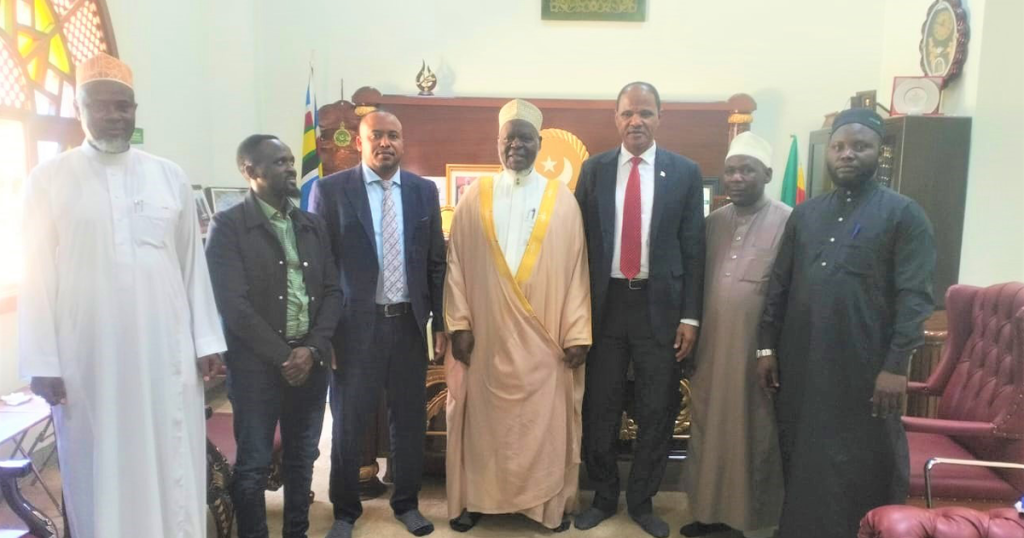
H.E. Ahmed Ibrahim, the Ambassador of the Republic of Sudan, has paid a courtesy visit to His Eminence Dr. Sheikh Shaban Ramadhan Mubaje, the Mufti of Uganda, at his office at the Uganda Muslim Supreme Council (UMSC) headquarters on Old Kampala Hill on Wednesday mid-morning, February 11, 2026.
Ambassador Ahmed informed the Mufti that his short visit was intended to brief him on the current state of affairs in Sudan, which has been affected by an ongoing internal conflict inflamed by insurgents. The conflict has resulted in merciless killings of ordinary citizens, displacement of people from their home areas, destruction of property, and nearly ten million able-bodied Sudanese fleeing the country. Many are now living as refugees in different countries, including Uganda, which is hosting over one hundred thousand of them.
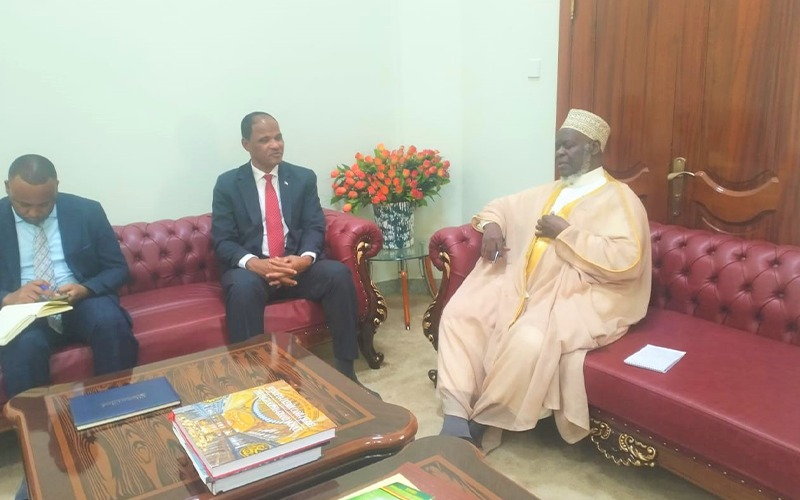
The visiting Ambassador disclosed that the Sudanese Government, under H.E. President Abdel Fattah Al-Burhan, who is at the forefront of command of the Sudanese Army, has faced several blows and setbacks in what he described as ill schemes aimed at destabilizing the North Arab African country and the entire region.”The situation is now returning to normal, with peace being restored in many places, including Khartoum Capital City, which is now fully under the Government,” he remarked in Arabic.
In addition, Ambassador Ahmed shared two documents entitled The Kampala Declaration: Pan-African Declaration on the Sudan Crisis, Resisting Foreign Invasion & Reclaiming Sovereignty, which was adopted by 92 delegates who attended the Symposium on African Peace and Stability. The delegates were drawn from political, cultural, academic, youth, women, civil society, and diplomatic institutions. They convened under the banner, “Sudan at the Frontline: Resisting Imperialism, Reclaiming African Sovereignty,” at a meeting held in Uganda on December 16, 2025.
The participants passed several declarations, among them the rejection of all forms of imperial interference and foreign-backed political engineering in Sudan. They called upon all African states to align their foreign policy with Pan-African ethical commitments rather than narrow strategic interests. They also condemned all militia groups, particularly the RSF/Janjaweed, which they described as fully sponsored by foreign powers and responsible for the bloody conflict in Sudan.
The Ambassador also shared a four-page document titled The Government of Sudan’s Peace Initiative, presented by H.E. Dr. Kamil El-Tayeb Idris, the Sudanese Prime Minister, during the United Nations Security Council meeting held on December 23, 2025, in New York, USA. The document highlights several steps to be taken in restoring total peace in Sudan.
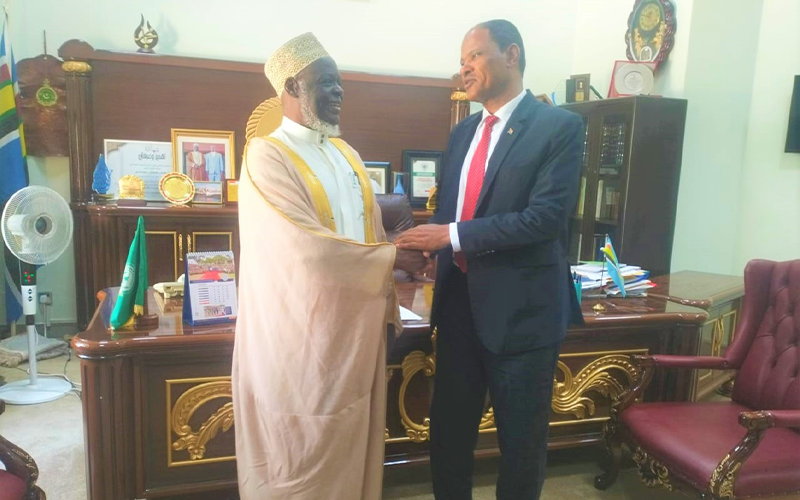
The Ambassador concluded by requesting closer cooperation with the Mufti’s Office, especially in social activities such as welfare programs aimed at providing assistance to refugees during special seasons like the Holy Month of Ramadan, which is due in the coming week. He also requested special supplications during Friday congregational prayers, beseeching Almighty God to enable the people of Sudan to reconcile for the sake of stabilizing their country. Lastly, he implored Muslim clerics during their Friday sermons to inform congregants that the current situation is normalizing so that Sudanese refugees may begin considering returning home.
In his response, the Mufti highlighted his several past visits to Sudan in his capacity as Co-Chair of the African Council of Religious Leaders – Religions for Peace (ACRL-RfP), where he has been promoting dialogue and peaceful resolution of conflicts in the region.
“We are delighted to hear that the situation is returning to normalcy, and we pray that peace is fully restored in Sudan,” Mufti Mubaje said.
He added that Sudanese citizens who return first and find the situation peaceful will naturally circulate the information to the rest of their countrymen living in different parts of the world.
Lastly, the Mufti noted that the peoples of Sudan and Uganda are closely related, not only by historical ties but also culturally, religiously, and in all spheres of life. He therefore welcomed the idea of a closer working relationship.
In attendance were UMSC departmental heads, including Sheikh Ali Juma Shiwuyu, Secretary for Hajj and Umrah; Sheikh Imran Abdnoor Ssali, Secretary for Religious Affairs; and Nasser Musa Odongkara, Secretary for Awqaf and Property.